Key Takeaways
- PE sintered cartridges are rigid depth filters—they trap particles through the thickness, not just on the surface.
- They handle turbidity spikes and pressure swings without deforming like softer media can.
- In many systems, they’re cleanable, which can slash lifetime cost and downtime.
- They’re especially useful as RO/UF prefilters and equipment protection in industrial water loops.
- Choosing the right micron rating + housing + cleaning plan matters more than brand hype.
Introduction
You want the short answer? Here it is: polyethylene (PE) sintered filter cartridges are ideal for water treatment because they deliver stable depth filtration in a rigid structure that tolerates real-world water variability—sediment surges, pressure pulses, and inconsistent influent—while often allowing cleaning and reuse to cut changeouts and operating cost. If your system lives in the land of “today’s water is not like yesterday’s,” PE sintered cartridges bring calm. They keep flow steadier, protect downstream gear like pumps and RO membranes, and usually fail slowly (predictably) instead of suddenly (expensively).
Now let’s get into the stuff most product pages avoid.
Water Treatment Isn’t a Lab. Stop Buying Filters Like It Is.
If your filtration plan assumes steady turbidity, steady flow, and steady operating discipline… I have bad news. Water has a personality. It changes with weather, upstream operations, pipe scale, maintenance events, even the mood of a settling tank.
That’s why I’m biased toward filters that behave well under “ugly” conditions—filters that don’t collapse when life gets messy.
PE sintered cartridges tend to be that kind of filter.
What Makes a PE Sintered Cartridge Different
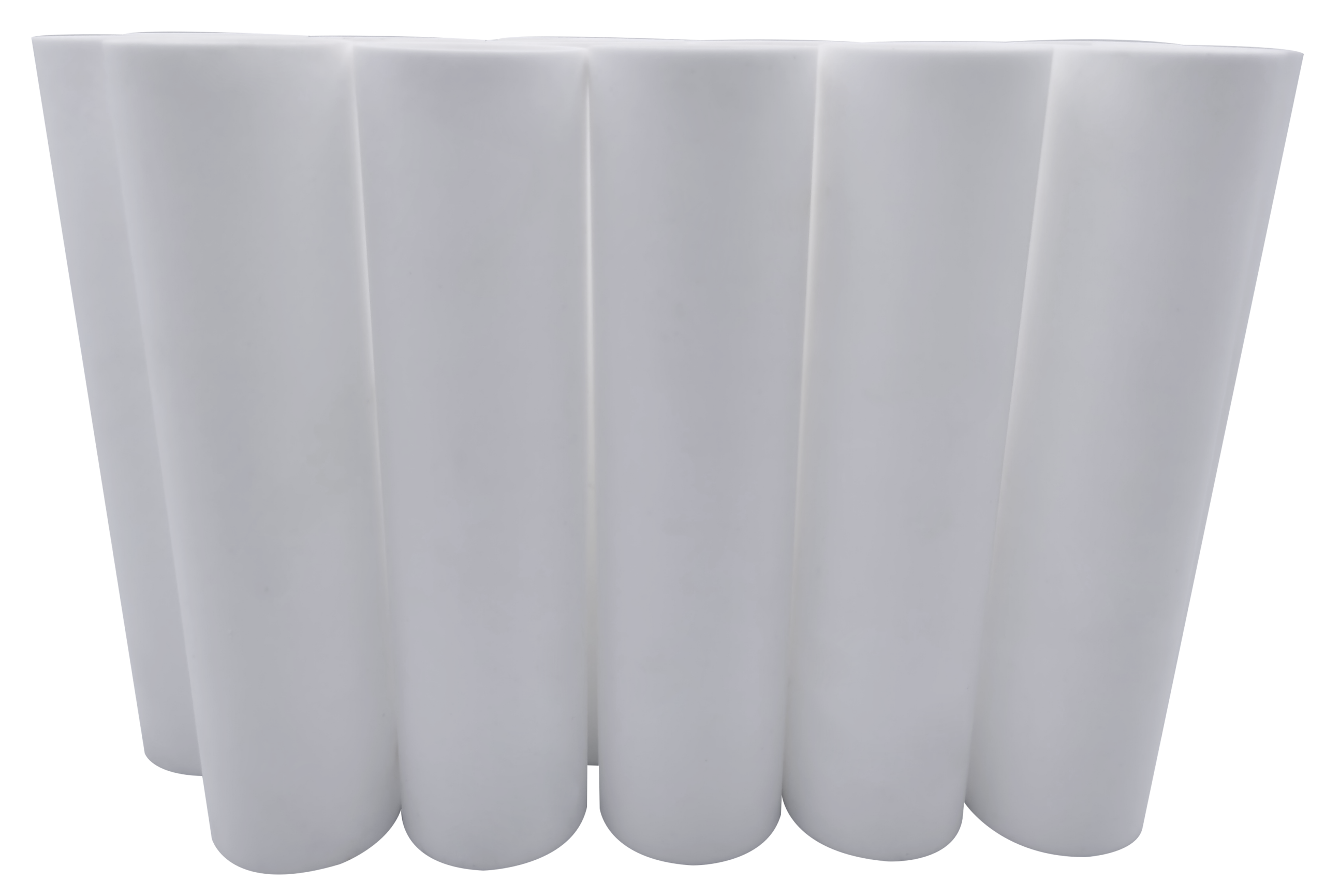
A sintered PE cartridge is basically polyethylene powder fused into a porous, solid matrix. Think “engineered sandstone,” but plastic and controllable.
H3: The important part is the 3D pore network
Instead of a fluffy fiber bed that can compress or channel, you get a rigid maze. Particles don’t just stack on the surface; they get captured throughout the structure.
In water treatment, that translates to:
- higher dirt-holding potential (often),
- smoother differential pressure rise,
- fewer “instant clogs” when influent spikes.
The Three Reasons PE Sintered Filters Win (In Real Plants, Not Brochures)
1) Rigidity: they don’t “breathe” under pressure
Some cartridges subtly compress when ΔP climbs, and that’s where the drama starts: channeling, bypass paths, unpredictable run times.
PE sintered structures are rigid. When pressure pulses happen (and they will), they’re less likely to deform and change behavior mid-run. For operators, that’s gold—because predictable filtration is easier to manage than “surprise filtration.”
2) Depth loading: they’re not surface-only divas
Surface-loading filters can be fantastic for polishing clean water. But when solids load varies, surface loading can turn into a traffic jam at the entrance.
Depth loading spreads the capture through the cartridge thickness. It’s the difference between:
- a single-lane bridge (surface loading)
- and a multi-lane tunnel system (depth loading)
3) Cleanability: sometimes you get to reuse instead of replace
Here’s where the economics get interesting.
If your foulants are mostly sediment (sand, rust fines, inert particulates), and your setup supports flushing/cleaning, you can often extend life meaningfully. Not always. Not forever. But enough to change your cost per treated cubic meter.
And yes—this is where many plants quietly win without bragging about it: they stop treating filters like disposable tissues and start treating them like tools.
Where PE Sintered Cartridges Fit Best in Water Treatment
H2: RO / UF Pretreatment (Membrane Protection)
If you run reverse osmosis or ultrafiltration, you already know the villain: membrane fouling.
The job of pretreatment isn’t “make the water perfect.” It’s:
- reduce particle load,
- stabilize feed quality,
- keep SDI and turbidity in check (as much as possible),
- prevent sudden fouling events that wreck membrane life.
PE sintered cartridges do well here when the upstream water isn’t reliably clean—think municipal variability, groundwater swings, or industrial influent with occasional “events.”
H2: Industrial Process Water Loops
Process water is the junk drawer of fluids. It collects everything:
- pipe scale,
- corrosion products,
- fines from production,
- occasional “who spilled what?”
PE sintered cartridges are often used as protective filtration for:
- spray nozzles,
- valves,
- pumps,
- heat exchangers,
- recirculating rinse loops.
H2: Wastewater Polishing (After the Heavy Lifting)
Let me say this clearly: cartridges are not where you remove chunky solids. Do the big work upstream—settling, screening, clarification, DAF.
But after that, when you need to polish fines, stabilize effluent, or protect equipment, PE sintered cartridges can be a dependable step.
The Part Everyone Messes Up: Micron Rating and Flow
H3: “Smaller micron” is not automatically better
Buying too fine a cartridge too early is like putting a coffee filter on a fire hose. You’ll get:
- rapid ΔP rise,
- reduced flow,
- constant changeouts,
- operators opening bypasses (because production always wins).
A smarter approach:
- coarser prefilter → protect the finer stages
- match micron rating to solids load and protection goal
- treat filtration as a train (multiple cars), not a single hero
H3: Nominal vs. absolute ratings—don’t get fooled
Micron ratings can be “nominal” (roughly) or “absolute” (tighter definition), and different manufacturers mean different things. The right question isn’t “what micron is it,” but:
- what does it protect,
- under what flow rate,
- with what solids load,
- for how long before ΔP becomes unacceptable?
“Okay, But Is PE Chemically Resistant Enough?”
For typical water treatment chemistry, PE often holds up well—especially in applications dominated by water, particles, and moderate chemical exposure.
If your world includes very aggressive solvents or extreme temperatures, you might look at PTFE. But most water treatment operations don’t need PTFE’s superpowers; they need reliability at a sane cost.
A Practical Selection Checklist (What I’d Ask If I Were Buying)
H3: 1) What’s the water doing on its worst day?
Not the average day. The worst day.
- storm runoff turbidity?
- backwash carryover?
- tank upset?
- construction disturbance?
Filters are sized for “bad days,” not the fantasy spreadsheet.
H3: 2) What’s downstream and expensive?
- RO membranes?
- UF modules?
- precision valves and meters?
- spray nozzles?
Your cartridge is a bodyguard. Know who it’s protecting.
H3: 3) What’s your acceptable ΔP window?
Every system has a point where flow drops, pumps complain, or energy cost spikes. Define the “replace/clean” threshold, or you’ll run on vibes.
H3: 4) Do you actually have a cleaning plan?
If reuse is part of the strategy:
- how will you clean (flush/backwash/chemical)?
- how often?
- how do you confirm performance after cleaning?
No plan = “reusable” becomes a nice word on a slide deck.
FAQ (People Also Ask)
Are PE sintered filter cartridges good for municipal water treatment?
They can be, especially for prefiltration and protective filtration where influent quality varies. Suitability depends on solids load, flow rate, and cleaning/maintenance practices.
Do PE sintered cartridges work for RO pretreatment?
Yes—commonly used to reduce particle load and stabilize feed, helping protect RO membranes. The right micron rating and housing design matter.
Can PE sintered filters be cleaned and reused?
Often yes for sediment-type foulants. Reuse economics depend on contamination type, cleaning method, labor cost, and how well performance recovers.
What’s the biggest advantage over melt-blown cartridges?
Rigidity and depth loading behavior. PE sintered cartridges are less prone to deformation and can offer more predictable ΔP rise under variable conditions.
How do I choose the right micron rating?
Base it on downstream protection and solids load. Avoid over-filtering early; consider staged filtration if influent variability is high.
Final Thoughts
Water treatment is basically a long negotiation with unpredictability. Some filtration media negotiate politely and then collapse when things get tense. PE sintered cartridges tend to just… keep working. They’re rigid, depth-loading, and often cleanable—three traits that matter more in real operations than fancy claims about “high efficiency.”