Key Takeaways
- Choose PTFE when chemicals are nasty, temperatures are high, or you need maximum chemical resistance (and you can live with the price).
- Choose PP for a huge range of industrial fluids, great cost/performance, and solid chemical compatibility in many acids/bases.
- Choose PE when you want tough, impact-resistant, often more “forgiving” filtration for water-like fluids at moderate temperatures.
- Choose PA (nylon) when you need higher mechanical strength, abrasion resistance, or specific solvent behaviors—but watch moisture absorption.
- Micron rating alone is a trap: flow rate, porosity structure, wettability, and differential pressure decide whether the filter behaves or rebels.
Introduction
You’re not really choosing “a filter.” You’re choosing a polymer personality that will either cooperate with your fluid… or slowly sabotage your process while smiling politely on the spec sheet.
If you’re stuck between PE, PP, PTFE, and PA (nylon) sintered filter cartridges, here’s the blunt truth: the “best” material is the one that survives your chemistry + temperature + cleaning method + pressure drop reality without shedding, swelling, cracking, or clogging like it’s getting paid per blockage.
And yes—your fluid is always weirder than you think.
The 30-Second Material Picker (Direct Answer)
If you need the quick answer:
- Pick PTFE for harsh chemicals (strong acids/bases, aggressive solvents), higher temperatures, and when “failure” is not an option.
- Pick PP for the best all-around industrial value—great for many chemicals, water treatment, and general filtration at moderate temperatures.
- Pick PE for robust, impact-tough filtration in water-like fluids and moderate conditions, often with excellent mechanical resilience.
- Pick PA (nylon) when you want strength and abrasion resistance, but be mindful of moisture uptake and compatibility quirks.
That’s the headline. Now let’s make sure you don’t regret your choice.
Why Material Choice Matters More Than Most People Admit
Here’s the ugly truth: two cartridges can share the same micron rating and still behave like completely different species.
Why? Because sintered plastic filtration isn’t just a “hole size” game. It’s a messy cocktail of:
- Porosity and pore geometry (uniform vs gradient, tortuosity, interconnectivity)
- Surface energy / wettability (hydrophobic vs hydrophilic behavior)
- Chemical resistance (swelling, embrittlement, stress cracking)
- Thermal limits (softening, creep, dimensional drift)
- Mechanical strength (compressive strength, abrasion, impact)
- Cleaning method (backwash, ultrasonics, solvents, steam)
If your cartridge survives the lab and dies in production, it usually wasn’t “bad quality.” It was a bad match.
The Four Big Decision Factors (The Stuff That Actually Breaks Filters)
Compatibility charts are useful—but they’re not gospel. Concentration, temperature, and exposure time change everything.
- PTFE is the “chemistry doesn’t scare me” choice.
- PP handles a lot, but strong oxidizers and certain solvents can be a bad day.
- PE can be surprisingly resilient, but it’s not the king of aggressive chemistry.
- PA (nylon) can be excellent in some environments and awful in others—especially where water absorption changes dimensions.
If your fluid is proprietary, secret, or “a blend,” assume the blend is plotting against you.
2) Temperature (Softening, Creep, Long-Term Stability)
Short bursts at temperature are different from 24/7 heat soak.
- PTFE stays calm where others get wobbly.
- PP is often a safe mid-range choice in many industrial scenarios.
- PE is typically more limited at elevated temperatures.
- PA can handle heat decently, but its behavior can shift with moisture content.
3) Wettability & Flow (Hydrophobic Filters in Water = Comedy)
A hydrophobic surface filtering water can trap air, resist wetting, and cut flow like a passive-aggressive manager.
- PTFE is famously hydrophobic (great for gases, solvents; sometimes annoying for pure water without pre-wetting tricks).
- PP and PE are also generally hydrophobic to varying degrees, but in real systems they often “behave” better depending on conditions and surface treatments.
- PA tends to be more hydrophilic than PTFE/PP/PE, which can be helpful in aqueous filtration.
4) Mechanical Abuse (Vibration, Pulses, Abrasion, Handling)
If your cartridge gets dropped, hammered by pulses, or faces abrasive particles:
- PE often shines for toughness.
- PA is a beast for strength/abrasion in many cases.
- PP is solid but can be less forgiving in certain mechanical extremes.
- PTFE is chemically tough, but mechanically it’s not always the “strongest brawler” unless designed appropriately.
Material-by-Material Breakdown (With Real-World “Gotchas”)
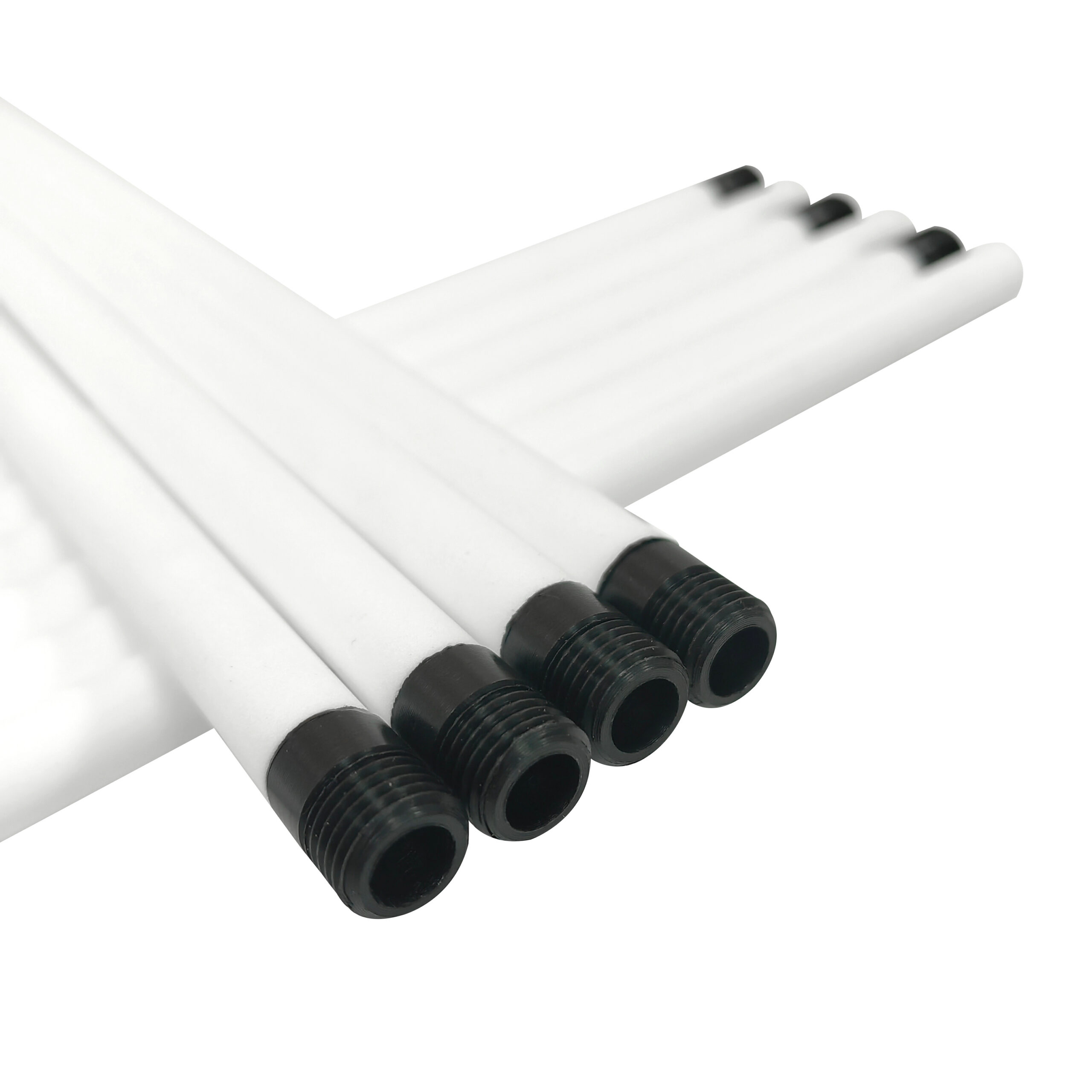
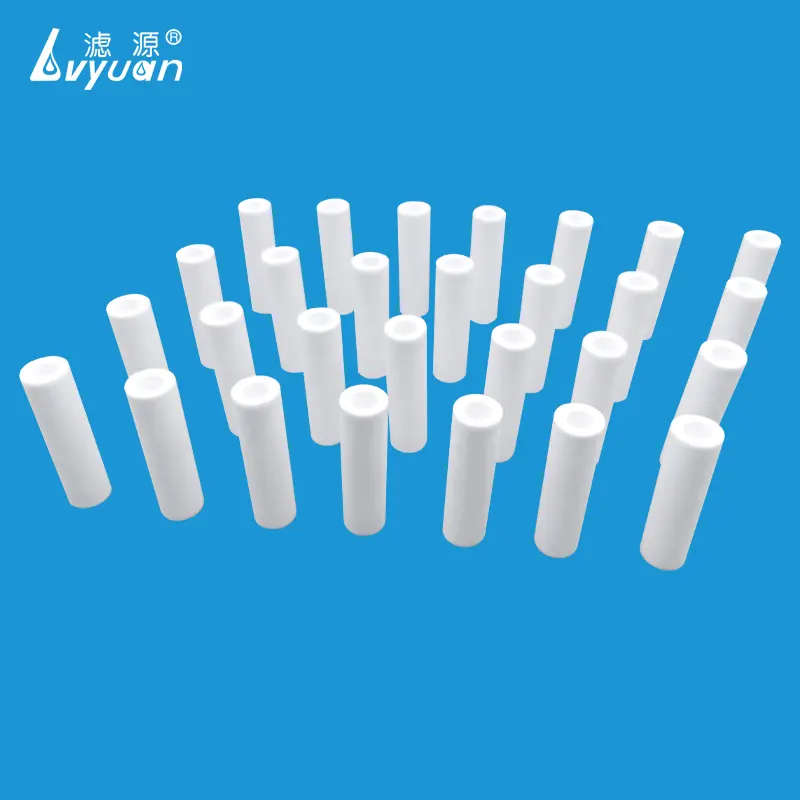
PE Sintered Filter Cartridges (Polyethylene)
When PE is the smart choice
PE is the practical workhorse that doesn’t complain much. I like PE when you need a cartridge that can take handling abuse, resist impact, and filter water-like fluids in moderate conditions.
Common wins for PE:
- Water filtration pre-treatment
- Industrial fluid filtration (non-aggressive chemistries)
- Applications where the cartridge gets bumped, vibrated, or swapped often
The gotchas
- Elevated temperature headroom is typically lower than PP/PTFE in many real installations
- Chemical resistance is good in many cases, but not the “bring it on” level of PTFE
PP Sintered Filter Cartridges (Polypropylene)
Why PP is the default for a reason
PP is often the best cost-to-coverage material in industrial filtration. It’s the “I want something that works for most jobs” polymer—especially in chemical processing, water treatment, and general industrial filtration.
Common wins for PP:
- Broad chemical compatibility for many acids/bases
- Good balance of strength, stability, cost
- Widely used in process filtration and OEM builds
The gotchas
- Some solvents and oxidizers can cause swelling, cracking, or long-term embrittlement
- At higher temps under pressure, “creep” can become a design factor (depends heavily on geometry and support)
PTFE Sintered Filter Cartridges (Polytetrafluoroethylene)
When PTFE is non-negotiable
PTFE is the “I don’t want surprises” material—especially when chemicals are aggressive, temperatures are high, or purity matters.
If your fluid sounds like it belongs in a hazard training video… PTFE should be on the shortlist.
Common wins for PTFE:
- Excellent chemical resistance (many strong acids/bases, solvents)
- Great thermal stability
- Often chosen for corrosive chemical filtration, high-purity processes, and solvent filtration
The gotchas
- Cost: PTFE rarely wins budget awards
- Hydrophobicity: can be annoying for aqueous systems unless you design for wetting (pre-wet, surfactant, pressure strategy, etc.)
- Mechanical design matters: thin PTFE structures can deform if poorly supported (not a PTFE “problem,” a design problem)
PA (Nylon) and Other Sintered Engineering Plastics
Where PA earns its keep
PA (often Nylon 6 or Nylon 66) shows up when you need mechanical strength, abrasion resistance, and certain performance traits that commodity plastics can’t match.
Common wins for PA:
- Abrasive particle filtration where wear matters
- Strong structural requirements
- Situations where a more hydrophilic behavior is helpful in aqueous filtration
The gotchas
- Moisture absorption: nylon can absorb water, changing dimensions and mechanical behavior (sometimes subtly, sometimes dramatically)
- Compatibility can be excellent or terrible depending on the specific chemical environment
- “Other engineering plastics” vary wildly—POM, PVDF, PEEK blends, etc., each with their own personalities (and price tags)
Stop Worshipping Micron Ratings (They’re Only One Piece)
Micron ratings are like asking someone’s fitness level based on shoe size. You’ll get a number, sure. But it won’t tell you what happens under stress.
What you should evaluate instead (or in addition)
- Flow rate at a defined differential pressure (ΔP)
- Dirt holding capacity (how long until clogging becomes performance loss)
- Pore structure (uniform vs graded)
- Viscosity and temperature of the fluid
- Particle type (soft gels vs hard grit vs fibrous contaminants)
- Cleaning method & cycle count (how many times you expect to regenerate it)
If you want fewer failures, stop asking “What micron?” and start asking “At what ΔP and flow, for how long, and how do we clean it?”
Application-Based Recommendations (Because Context Is Everything)
Water & wastewater (aqueous, moderate temps)
- Often PP or PE
- Consider PA if wetting and certain mechanical needs matter
- PTFE only if chemistry is harsh or cleaning is aggressive
Corrosive chemical filtration (strong acids/bases, mixed solvents)
- PTFE is usually the grown-up choice
- PP can work in many chemicals, but verify your concentration/temp
Solvent filtration / high-purity processes
- Frequently PTFE
- Watch extractables, cleanliness, and pre-wetting behaviors if aqueous steps exist
Abrasive slurries / particle-heavy streams
- PA or robust PE designs can outperform
- Geometry and support strategy matter as much as material
Practical Spec Checklist (What I’d Ask You If We Were On a Call)
Give me these, and I can usually tell you the right polymer in five minutes:
- Fluid identity (and concentration—no vague “cleaner” answers)
- Operating temperature (normal and worst-case)
- Flow rate target and allowable ΔP
- Particle type and expected loading
- Cleaning method (backwash? solvents? ultrasonics? steam?)
- Connection type & dimensions (OD/ID/length/end caps)
- Regulatory needs (food contact, pharma requirements, etc.)
- Expected service life and replacement strategy
If any of those are unknown, you’re not selecting a filter—you’re gambling with plastic.
FAQ (People Also Ask)
What’s the best material overall: PE, PP, PTFE, or PA?
There isn’t one. PP is often the best general-purpose balance. PTFE wins for harsh chemistry and heat. PE wins for toughness in moderate conditions. PA wins for strength/abrasion—if the chemistry and moisture behavior cooperate.
Is PTFE always better than PP?
No. PTFE is usually more chemically resistant, but it can be more expensive and sometimes trickier in water-based filtration because of hydrophobic wetting issues. If PP covers your chemistry and temperature, PP can be the smarter, cheaper choice.
Which material is best for aqueous (water) filtration?
Often PP or PE, depending on temperature, mechanical needs, and contaminant type. PA can be attractive when wettability matters. PTFE can work, but you may need pre-wetting strategies.
Which one handles the highest temperatures?
Typically PTFE. After that, it depends on exact grades and design, but PTFE is the standard pick when heat is a main villain.
Why does my filter clog too fast even with the “right micron”?
Because clogging is more about pore structure, particle type, and dirt holding capacity than micron rating alone. A “5 micron” filter can choke quickly if the pore pathways load up with fibrous or gelatinous contaminants—or if your ΔP and flow are mismatched.
Can sintered plastic cartridges be cleaned and reused?
Often yes—depending on material and contaminant. Backwash, ultrasonics, and chemical cleaning can work. But cleaning chemistry must match the polymer (PTFE tolerates more; PA’s behavior can shift with water/chemicals; PP/PE need compatibility checks).
Final Thoughts
If you take one thing from this: material selection is risk management.
- If your process is chemically aggressive or hot, PTFE is your insurance policy.
- If you want the best “covers most cases” value, PP is hard to beat.
- If you need toughness and practical resilience in moderate conditions, PE is underrated.
- If your world is abrasive, structural, or wetting-sensitive, PA (nylon) can be the quiet hero—right up until moisture or chemistry proves it’s got moods.
Paste your Internal Links JSON and I’ll thread the exact keywords into this post cleanly (5–8 links), plus I can tailor the recommendations to your target industries (water treatment, chemicals, pharma, food & beverage, semicon, etc.) without turning it into a brochure.